“A nation that destroys its soils destroys itself.”- FDR
One of the most underappreciated geological creations is soil. People often confuse soil for dirt and dirt for soil. Soil is comprised of decayed rocks, minerals, and plants that form layers or horizons over an extended period of time. Soil is a living ecosystem where bacteria, fungi, arthropods, worms, and more live and thrive. Dirt, on the other hand, is made up of sand, silt, and clay. It has no living organisms, minerals, or nutrients found in it. I often get offended when people call soil dirt. Dirt implies that something is dispensable or insignificant to someone. I can assure anyone that without soil, humanity would seize to exist as we know it! My soils professor at Lincoln Land Community College always taught me to not treat soils like dirt and appreciate all that soil does for the world. My appreciation for what soil does for all of us is profound and resounding. I just wish that others shared my appreciation and concern for soils, too
Think about all of the foods that require soil to grow? Think about all of the animals that rely on us to feed them? This reliance first comes from the soil. Everything from fruits and vegetables to beef and pork require fertile soil to produce. Basically, no foods could be produced without a fertile environment to grow in. In this case, that environment is soil. I perceive soil as a foundation of a building. That building is all of humanity. If the foundation is precarious or weak, the entire building will fall. What I learned from my environmental science class at my community college is that everything is connected to each other in some way. Soil is related to the basic need that keeps humanity to perishing. That basic need is food. No one knows what the future will hold for anything. This is especially true when it comes to soils. I am very concerned that more and more soil will be gone in the future due to the growing population of the world and adverse environmental conditions. What I can predict, however, is that more attention and conservation practices will have to be implemented if soil is to be around as along as humanity is.
About the Author
Hi everyone! My name is Nick Young and I’m a junior at Western Illinois University majoring in ag science. Agriculture has always been a major part of my life. My mom’s side of the family are all farmers. They own 1000 acres in Greene County. Every now and again I will go down there and help them get the crop out of the field. The farm is almost 100 years old and is continuing to grow. I was fortunate enough to spend four years of my life working with the former Secretary of Agriculture for Illinois. His name is Tom Jennings. Tom encouraged me to switch my degree from law enforcement to agriculture. Since then, I haven’t looked back and I’m really glad I switched degrees. I am hoping to stay in Illinois and possibly work for the company Brandt. Brandt was actually founded in the town that I went to high school. I went to Pleasant Plains High School from 2014 to 2018.
Ever since I was able to walk you could find me beside my dad. I always wanted to be like him from “reading” the sale cattlelogs with him, carrying feed buckets to the heifers in the barn, and even trying to fit the back leg of a calf at the cattle shows we would attend. My dad taught me everything I know and instilled in me the love for Shorthorn cattle. Being a 4th generation shorthorn producer it only seems fair to say that in runs in my blood, and I am proud to say I bleed red, white, and roan.
Me when I am 4 years old next to my dad fitting on a heifer
My love and passion for the shorthorn cattle grew stronger each day and seemed second nature to raise them myself. From the day I bought my first heifer calf out of K Kim Cash x Mona Lisa 1084 from JM Cattle Company, I knew my future was going to be filled with quality shorthorn and I couldn’t wait to continue to grow my herd. As I got older the more involved within the shorthorn industry I became from attending numerous cattle shows, ever since I was six months old, from jack-pots, county, state, and national levels and participating in nearly all the junior national contests offered. One thing I always looked forward to seeing at all these events was the Lassie Queens. At first I always thought it was odd to be wearing a plaid skirt to a cattle show especially in the summer time, but as time went on my appreciation for the lassies and the tradition they carry on only grew. However, I will be the first to admit pre-teen Emily could not see herself wearing the lassie costume and I swore I would never become a lassie. Well I quickly learned never to say never because when I turned fifteen years old I was asked to be the Indiana State Lassie Princess and ironically enough I agreed, solely because I could wear jeans being the princess.
Me and Don Washburn at the Indiana State fair after working the ring my first year as a lassie.
Now I know what you’re thinking, she couldn’t just say no to becoming the Indiana Shorthorn Lassie Queen when I came of age now couldn’t I. Sure enough I fell in love being a lassie that I was the state queen for two years and throughout my reign I attended all the state shows for shorthorns and meet with some of the most influential shorthorn producers and cattle evaluators like the Ryan Rash. I remember the day I got to meet Mr. Rash at the 2017 Indiana State Fair Shorthorn open show and let me tell I have yet to be captivated listening to anyone describe and evaluate cattle like him on that day. To make this particular day even more memorable when it came to my duty to be at the backdrop for photos Mr. Rash complimented me on my crown and I instantly asked if I could have my picture with him and he was very humbled to get his picture taken.
My mom was very quick to capture me meeting Ryan Rash right before I had to step in for pictures along side my cousin
I thoroughly enjoyed my time as the state queen but like any young ambitious woman I knew that my time as a lassie was setting me up to run for the National Shorthorn Lassie Queen which I did when I was a senior in high school. The process to apply for the National Queen was a combination of me nagging my mom or dad to take me to cattle sales, shows or any event shorthorn related as well as filling out the extensive application and creating my picture book so the National Lassie Queen Board could truly get a grasp of just who I am how important being a Lassie is to me along side the shorthorn breed itself. The process to run for queen truly began by traveling to Louisville, KY for NAILE for the Shorthorn open and exhibitor show as well as helping with the annual Deck the Stalls auction, an interview and social with the current queens and board members. On the final day of the shows the winner for the National and Alternate Lassie Queen would be announced and I was more nervous walking in one of the last classes for the day because right before the Grand Drive than I was standing out in the middle of the ring with my dad waiting for the results. The pressure I felt with the entire east ring side watching me and my fellow queens made me shake in my boots that when I heard my name called for the 2018-2019 National Shorthorn Lassie Queen I couldn’t help but let the tears fall from my eyes, hear the crowd erupt with hoots and hollers, and to feel my dad embrace me with a proud look on his face washed away in a mere second.
Me along side my biggest supporters, my family
Having accomplished one of my life time goals at only 18 truly gave me a sense of pride. In my year reign I was very fortunate enough to travel to Denver for the National Western, Junior Nationals in Tennessee where Dr. Mark Hoge spent countless hours judging the purebred heifers. His only negative statement of the entire day was next time he’s going to ask the exhibitor if their heifer can take a quick and easy picture, because the Grand Champion Shorthorn heifer would not stand still to save her life. Other than attending shows, sales, and conferences which were all life changing for me the important factor to me was the opportunity to meet with producers and promote a breed that is dear to me and others especially when shorthorns have gained a negative or unappreciated reputation. I know each breed has its flaws as anything does in life, it was my goal to get young ladies interested in becoming a lassie or even help the breed itself gain a better reputation. I accomplished these both by speaking with a young lady from my home state about becoming the state queen and every time I put on my lassie costume I felt that I best represented a breed that deserves to get the same attention they had when they were first introduced. To this day I continue to encourage girls to give it a chance because I never saw myself becoming a lassie and I don’t regret a single minute I spent in the plaid that carries the origin and pride of the shorthorn industry. Shorthorn cattle may not be what they used to be and as popular when I was growing up but I will stand behind their natural “ability to be docile, good reproductive performance, adaptability, and longevity.” The plaid I wore not only represented me and the breed I love but the history, tradition, and producers like my dad, the man who showed me how to care for livestock, evaluate them, and to strive to make them better. I encourage any young lady to step out of their shell and find those unique ways to promote what they are passionate about because I am so glad I did!
Me and my Dad together at NAILE when it was my turn to pass the crown on to the next National Lassie Queen in 2019
Hello, my name is Emily Fry and I am from Danville, IN, where I grew up on my family’s cattle, sheep, and hog operation. I am currently a junior at Western Illinois University majoring in Agricultural Business and minoring in Animal Science. I am currently on the livestock judging team and after college I would like to either get my masters in genetics/reproduction or begin my career working for a company dealing with daily reproduction work, primarily embryology. I hope that you enjoyed my post and thank you for taking your time to read this!
“I love to fish because it is totally relaxing. I love the water. I can concentrate and forget all my worries. I count my blessing while fishing.”
– George W. Bush
As a kid, growing up in a small town surrounded by corn was difficult at times. There was not that many activities to do because everything was so far away. The only thing that was remotely close was a tributary known as The Rock River that connects into one of the more well known rivers, The Mississippi River. My older brother, Anthony, was the person who always walked me to the river all the time when I was younger. We use to always go to the river right before sunset and throw rocks into the water or to just watch the calm water shift towards the sunset. To me, hearing the river made everything so peaceful and I enjoyed seeing all the different types of aquatic life.
When I turned 8 years old, my parents bought me a Scooby-Doo fishing pole for one of my presents. At the time I was not to thrilled about the fishing pole because as a kid, the only presents I wanted was some Legos or a new video game. At the time, I thought I was never going to use the fishing pole and it will only collect dust in my garage, boy was I wrong. The next morning after my birthday, my father woke me and my brother up around 6 a.m. to start loading up the truck because he was taken us fishing for my first time ever. On the way to the water, it was still dark outside and the sun was just starting to rise over the horizon. We drove for about twenty minutes until we reached our destination known as Hennepin Canal which was right outside Geneseo. This canal was very special to my father because it was where his dad brought him for his first time fishing and where my father brought my brother for his first time.
As soon as we dropped our boat into the water and I saw all kinds of different aquatic life swimming around, I felt a good feeling in my stomach that made me realize how special these moments are with my family. We spent nearly three to four hours out on the canal just spending time with each other and trying to land a fish (That was the goal). For me, because it was my first time fishing, my dad put his full focus on me and helped me anyways he could to help me land a fish. He baited my hook, tied my lines, and even helped me learn how to cast my Scooby-Doo pole. In the end it was a success, in the last hour I hooked onto a Largemouth Bass, and had the fight of my life to bring the fish in. To this day, that Largemouth Bass is one of my top catches and is the main reason why I love fishing to this day.
Since the day I caught my first fish with my father and my brother, I tried to go fishing or learn about fishing any chance I could. I use to sneak out late at night after dinner and go fishing at The Rock River. I watched all kinds of fishing shows and tournaments with my dad. Through these shows and conversating with my dad, I learned so much about fishing that I felt like an expert whenever I actually went fishing. My dad really enjoyed my interest of fishing, that when I finally turned thirteen, my dad booked a two week vacation in June, for me and my brother to Tall Pines Camp in Ontario, Canada.
Brother and I fishing off the dock at Tall Pines Camp- Photo taken by Jeff Lester
Tall Pines is a resort in the northwestern part of Ontario that is around two-hundred acres of land and water. The camp is around thirty miles from any main land or business. When we finally arrived at the camp, you could tell we were in the middle of no where. The only things you could see is the giant lakes and forest all around, with the exceptions of all the wildlife. Through those two weeks of non-stop fishing came some of my favorite memories growing up. From sunrise to sunset we were fishing all day, catching (large and smallmouth) bass, perch, walleyes, northern pikes, and even some muskies from time to time. One day out of the trip, my dad booked a guide to fly us out to a remote lake more north then our camp. This lake was privately owned and rarely ever fished. To get to this lake, we had to take a floatplane to fly us out and land directly on the lake, there was no roads or trails to even get remotely close. This lake was very small, maybe five acres in total, but to this day was one of my favorite places I have ever fished. We fished for around six hours that day on the lake and caught over fifty fish through the three of us (mainly walleye). Overall, this trip made me really fall in-love with the outdoors because of how beautiful and peaceful nature really is when that is all you have for two weeks.
Me holding two Small-mouth Bass at Tall Pines Camp- Photo taken by Anthony Lester
When I got into high-school, I did not do much fishing because I was so busy with extracurriculars like football and FFA, plus trying to keep up with my grades. Through this I saw myself going down a deep depressing spiral because I felt like everything was a job to me and if I did not do perfect, I would lose everything I worked for. Until one day of my junior year, my high-school formed a bass fishing team. Many people in my school did not know I actually fished or even knew how too, so when I walked in for the first meeting, a lot of people were shocked. The team was formed by two farmers in our area that wanted their two sons to go and win state for our school. To me, this was one of my biggest challenges I faced during high-school because the odds of me even getting to fish was slim to none. But I did not give up, I went to every practice and showed everyone that I was a contender to be one of the top fishermen from our school. And I did, I was selected to the #2 boat for Riverdale and competed at sectionals with my teammate. In the tournament, each school was allowed two boats to enter, which gave your school two chances to go to state if either of the boats got 1st and/or 2nd. Through the eight hours of competition, me any my teammate filled the limit of our bag with five bass. In the last hour of the tournament, I actually hooked onto one of the biggest bass we caught all day which helped out in the end. As we got to the weigh-ins, you could feel the tension and nerves of all the competitors hoping their five fish weighed the most and that they could advance to state. At the time, Geneseo #1 boat was in first place with their five fish combining around twenty pounds. Riverdale was the last group to finish off the weigh-ins, Team #1 for Riverdale (which were the farmers sons) weighed their five fish and had a combined weight of around eighteen pounds, which actually moved them up to second in the standings (right behind Geneseo). Me and my teammate were the last ones to go up to the weigh-ins and I felt all the nerves and pressure hitting me. As we walked up and laid the bag onto the scale, the announcer for the tournament screamed “We might have a winner here.. nineteen pounds seven ounces.” Hearing that weight and knowing that me and my teammate beat team #1 for Riverdale was huge, and it was off the last bass I caught to put us in 2nd. My teammate and I fished at state that year and did not do the best. We only managed to catch three bass between the two of us throughout three days of fishing, but for me I already felt like a winner.
My teammate and I at sectionals during weigh-ins – Photo taken by Scott Searl
Through all my memories of fishing and being outdoors with my family or teammates, I always felt connected to nature. I strive being outdoors and just listening to the birds chirp or the wind whistling through the trees, which has brought me closer to the things I love. Since I’ve been at college, I have not been home a lot to go fishing from time to time like I wish I could. But when I do, I like to go fishing at places my dad use to take me all the time when I was a kid. The first place I went fishing when I got back home from college was The Hennepin Canal. As I arrived at the canal my heart broke, the canal was covered all in algae and slowly losing water each year. This is where I felt like it was my duty to help out and protect the canal and the wildlife living around it. The next year at college I changed my major and devoted my time to become a Wildlife Game Warden and help out all around the country to make our parks and waterways safe for wildlife for future generations.
Fishing has helped me become who I am today and helps me get away from the world from time to time when I need too. If it was not for fishing I feel like I would lost in this world with no way out, but when I fish, I forget about all my problems and just enjoy being outdoors for another day.
Hello everyone. My name is Jacob Lester and I am from Hillsdale, Illinois. I am a senior at Western Illinois University to receive my Bachelors in Science of Agriculture.
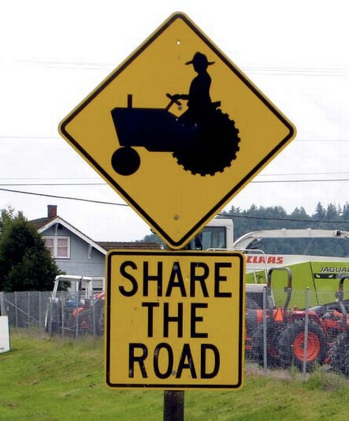
Driving down the load and seeing big flashing lights immediately I think “oh no is that an accident?” I get closer and still not sure what is ahead of me it’s dark out I’m going 55 miles per hour. I start to panic when I see a combine driving down the road. Next thought that passes through my mind is “what do I do.” It only takes a few seconds going 55 miles per hour to rear-end a tractor that’s only 300 feet away.
Many people hesitate while driving around farm equipment but there are ways you can stay safe and not end up hurt or in an accident. Grinnell Mutual gave safety tips and resources for how to drive safely around farm equipment. They state that it is first really important to watch for slow moving vehicles, and try to remember what time of year it is. You are going to see more farm equipment on the roads during harvest. Secondly don’t drive too close to the equipment. It scares the driver and puts him under a great deal of stress. It is recommended to stay about 50 feet away from the equipment. Country roads unlike the highway are not straight and have deep curves and sharp turns. Never try to pass farm equipment during a turn. They swing wide and make wide turns sometimes farmers will use their hands to signal meaning there is more evidence that they are turning which is a good indicator to slow down and let them take their time so you both can turn safely. A common mistake is to think that a farmer is moving aside to let you pass. Instead they most likely see something ahead like a turn and they are preparing to swing out. If you try to pass during this time, it is more common to cause an accident.
Sciencedaily.com reports that over 1,100 farm vehicle accidents causing sever or fatal injuries take place every year. Main two reasons for accidents are trying to pass or rear- ending the tractor. So let’s start paying more attention to road safety so both farmers and drivers can get where they are going quickly and safely.
“Setting a goal is not the main thing. It is deciding how you will go about achieving it and staying with that plan.”
Tom Landry
After visiting Western Illinois University for their Ag Open House in the fall of my junior year of high school, I made my mind up before we even ate lunch that day – this is the college I wanted to receive my bachelors from once I finished community college. I watched the Ag Vocator panel talk about their unique experiences, goals as students, having great transitions from community colleges, and why they chose Western. I found myself easily relating to these individuals and made it a point to strike up conversation with a few folks I knew and introduce myself to students with similar degree paths I was looking into. You could say this visit went pretty dang well….considering I decided to attend two more Ag Open Houses and a personal visit before I officially made my way to Macomb.
Those connections I made with individuals at that very first Ag Open House, led to many more conversations in the future. I began running into them at career fairs, FFA conventions and events, conferences, and school visits. They began recognizing me at these events because I always made it a point to visit with the Western booth if they were there. The most important of these encounters was with an Ag Vocator at the Women Changing The Face of Ag Conference my senior year of high school. She was in the exact program I wanted to pursue and she mentioned how she worked closely with a few professors out at the WIU Research Farm. Although, I’d been to Ag Open Houses, I wanted to get even more familiar with campus and the opportunities available, as well as shake some more hands. I got her number that day and set up a time to come get my personal tour of the campus, the Ag Department, tag along with her in classes all day, and even got to participate in a lab activity in one class. To finish off the grand tour, I got see the types of chores she did out at the farm for the professors. During our visit to the farm, she introduced me to Dr. Phippen and I got to understand more about his pennycress research program and how she got to assist with projects. Working hand in hand with university research like she’d been doing was exactly what I wanted to do when I made it to Western. My mind had been made up. I wanted that experience on my resume one day.
I had spoken with so many students and friends that had loved their time at community colleges and mentioned how easy the transition was to WIU. I knew I wanted to save as much money as possible by going to Lincoln Land Community College. Not to mention the whole idea of living in a dorm room freshman year didn’t quite strike my fancy. I finished my associates in a year and a half debt free thanks to scholarships, staying on track, and doing summer classes. I was determined to get on my way to the big city of Macomb as quick as I could. I wouldn’t be starting classes until January of 2021, but I wanted to be plenty prepared. If you haven’t noticed, I’ve got a thing for thinking ahead. By May of 2020 I already had planned out my living arrangements and coincidentally, one of my roommates was a fellow Lincoln Land alum, extremely active within the school of agriculture, an Ag Vocator, and a true mentor of mine. All of this planning, thinking ahead, and personal connections allowed me to fit right into the culture of WIU’s Ag Program.
Lori Jackson (soon to be future roommate) and myself at the Ag Open House in Fall 2019
After all those years of wanting to be a Leatherneck, I officially started that journey on January 19th of 2021. Things got busy real quick. I had some things to check off my list that first semester. First on my list was becoming an Ag Vocator. So as soon as the opportunity arose, I jumped after it. I am grateful enough to hold a position on the Ag Vocator team currently. A group that made a huge impact in my college decision process. My goal is to be that person or have that conversation that makes a difference in someones college/career decision. Besides Ag Vocators, I am also a member of many other clubs within the school of agriculture that have given me great opportunities. Also, I’ve had the opportunity to work under Dr. Phippen and his pennycress breeding research, something I was interested in doing since my tour back in 2019. Funny how things work out huh?
Talking to students at a career/college fair at Lincoln Land Community College for Ag Vocators
I am extremely lucky to have made my mind up my junior year of high school on the college/career path I wanted to pursue and believing in Western to achieve that. I know that everyone’s paths are different and sometimes it doesn’t come that easy, but sometimes it can. I encourage anyone who finds that connection with a college and is passionate about a certain career path to dive head first into making it possible. Having a plan and following it, working your tail off, and making those connects will be paramount in your success. Make that conversation and ask the questions, even if you feel like you are asking too many. People will remember you for being passionately curious.
Two other members of the Ag Vocator team and myself got the privilege of joining WIU President Guiyou Huang at his first-hand look at the harvest on the Ruebush-Lambert Farm outside of Macomb. This was his first time riding in a combine and learning about corn harvesting. Photo courtesy of Western Illinois University Visual Production Center
About the Author
Hi everyone! My name is Hannah Carlock and my hometown in Chandlerville, Illinois. I am a Junior majoring in Agriculture Science with double minors in Plant Breeding and Agronomy. I transferred to WIU from Lincoln Land Community College. I am involved in many clubs and organizations within the school of agriculture including: Collegiate Farm Bureau, Sigma Alpha Professional Agriculture Sorority, Ag Vocators, Ag Council, and Ag Mech. Upon graduating Western in December of 2022, I plan on continuing my education at University of Illinois Urbana-Champaign to achieve my Master’s in Crop Science. I have plans to pursue a career within crop research focused on breeding and genetics. Thank you for taking the time to read my blog!
Photo courtesy of Western Illinois University Visual Production Center
The foundation for one’s character may start from the day a person is born, while building passion, starts the first time you take a keen interest into a specific topic. Influences surrounding a person, whether they be a particular industry, a specific group of people, or a geographical region have more of an impact than what you may initially believe. Without passion for what one is doing, we settle for mediocracy. A label no person should be proud to wear. While every person may possess some knowledge of particular feats, each is to find their interests on their own. I believe that my story not only screams the truth of the benefits of a good community, strong family, and faith, but also that without the influence of the agriculture industry and people within it, I wouldn’t be where I am today.
A view of the foothills from our former property in California
Recent Trend
Farming in California has drastically evolved in the last two decades, leaving many families searching for the drive it takes to endure the hardships associated with producing a product to feed the world, including consumers that seem to work in opposition to agriculture each and every day. One of those families trapped in the downward spiral of regulations, gut wrenching losses, and constant pressure from the community not associated with agriculture, was mine. In California’s San Joaquin Valley, diversity is a plethora, water is scarce, and hard working people are tired. Despite the beliefs of those who may not recognize the size and scope of agriculture in the third largest state in this country, over 200 different crops are grown in the state, some grown solely in California. Some of the most fertile land in the United States is the foundation under multimillion dollar homes, a high speed rail to nowhere, or freeways between big cities. Unfortunately, agriculture is so unappreciated in many areas of our country that even the silent majority has begun to believe that we, as farmers and ranchers, are in the wrong for our way of life. Just as corporate officials work to provide for a family, agriculturalists toil in their fields, facilitate the best environments to raise livestock, just to produce a product they are proud to stand behind, and to keep a roof over their heads. Modern culture has driven the consumer to believe agriculture is unethical, unsafe, and not critical to life, a statement that couldn’t be farther from the truth.
My family farmed permanent crops for multiple generations, enduring the tough road to find opportunities as we saw fit at the time in California. We primarily farmed citrus in recent years, but previously had farmed a little bit of everything in the rich adobe clay soils. What once was arguably one of the most sought after places to live, has now become a political trap, of power seeking individuals, with little appreciation to where their food comes from. Creating an environment so atrocious that good people are fleeing by the thousands in search of opportunities that will not scrutinize one for choosing a particular way of life. Despite both of my parents being born and raised in arguably the worse state in this country, they chose to pursue a life in agriculture after graduating from California Polytechnic University in San Luis Obispo in the late 80’s. While one may find that choice hard to believe, opportunities were at every corner and the culture was ideal to raise a family. After living in the valley for over 30 years in a charming small town, we as a family chose to slow down our pace of life, and moved to southwest Missouri this past year, switching our focus from primarily farming with a livestock operation on the side, to a operation focused on raising high quality livestock. Uprooting our ties and moving 1685 miles from where we previously called home was surely decision that has changed our lives in the recent year, but was one of the easiest to make for the Midwest culture, great people, and a more enjoyable pace of life.
Agriculture as we all know it, is the greatest industry known to man. Tackling the battle of feeding a changing world, one that seems to want to make life hard for farmers and ranchers, is no easy task no matter the location. The baseline to life is connections, no matter how hard you work or how much talent you may have without knowing the right people, success becomes far fetched. Anything in life worth having does not come easy, and if its easy is likely that it will never mean as much to you. With that, I would like to extend my appreciation to all people who have had an impact on my life to this point.
California is our biggest economy. California is our biggest agricultural producer. So what happens here matters to every working American
Barack Obama, Former US President
My Roots
Raised by two of the hardest working, genuine, and honest people you could find, morals and ethics were instilled in me from an early age. Lessons aimed to teach children to complete the job, work a little harder, and to always put your best foot forward, were no rarity in the Dreyer household. My parents not only instilled a work ethic that has got me this far in life, but also valuable knowledge that without being a people person, only so much talent will lead to success. Nowadays many of my closest friends chastise me for “the little things”, going the extra mile or working just a little bit harder, but in the end it will be worth it, as I have found my passion, and work every day to achieve it.
A few fall born calves at our operation in Missouri
About the Author
My name is Brian Dreyer, I am currently a Junior at Western Illinois University, studying Agricultural Business. I am a member of the Alpha Gamma Rho Fraternity, Collegiate Farm Bureau, Hoof and Horn Club, as well as Ag Vocators. After obtaining a degree from WIU, I hope to pursue a career in sales in an aspect of the agricultural industry and run an excavation business specializing in a wide array of residential, and small commercial projects. I grew up in central California, but now reside in the great state of Missouri, where my family and I raise high quality purebred breeding cattle and show lambs. Look up Dreyer Show Stock on Facebook if you may have any interest in our operation!
The utilization of field drainage tile was first used in America in 1838. A farmer named John Johnson was the first to use clay tile on his farm in Seneca County, New York. The invention of tiling was then changed in 1860 when a man named Henry French wrote his book, “Farm drainage: the principles, processes, and effects of draining land with stones, wood, plows, and open ditches, and especially with tiles.” This book changed the way that tiling was viewed and made farmers, as well as others take a different look on how useful drainage is in farming. In today’s era we use plastic tile as a more secure material, then the later clay tiles that started field drainage. Individual ceramic tiles of fired clay was what John Johnson started using, which lasted a little over a hundred years. After so long farmers had found that there was a better, and easier, alternative to clay tile. In 1967 the first commercially manufactured corrugated-wall high-density polyethylene plastic drainage tile forever changed things for farmers. The invention of plastic drainage tile made the process of tiling much easier and allowed for longer usage. Not only has the tile itself evolved, the technology and equipment needed has as well.
When clay drainage tile was first applied, it was dug and placed in the trench all by hand. It was soon to find out that digging and placing tile by hand wasn’t always done right and it required a lot of work. Steam powered trenching tiling machines were available in the early 1880’s. In that time many farmers didn’t have the extra cash to buy the trenching machine, so they continued to tile by hand. Trenching machines use a wheel like set up that digs a trench while setting the tile in the trench, where a tile plow drives the pipe into the ground without digging a trench. In 1971 field testing and demonstrations showed how the Laser-Beam controlled plow successfully put plastic tile in the ground. This changed the accuracy of tile grade forever. If the tile doesn’t have the right grade, or depth, then it will not move water correctly. Trenching tiling machines and tile plows evolved as the years went on and as tiling became more popular. The Laser-Beam controlled plow changed the effectiveness of tiling. With the invention of technology that helps get the correct grade, comes the utilization of GPS. Global positioning system (GPS) allows for there to be documentation of where the tile is placed. This allows for easier identification of potential drainage problems and a pinpoint as to where to start if more tile is in the future. Drainage tile is a concept that was started by a small farmer that wanted to increase yields, and it has now evolved into a something that will forever be used by farmers.
Pictured above is my families two trenching tiling machines (left), and the tile plow (right).
How Drainage Tile Works
Tiling is a complicated process, but it is done to fix simple problems. Drainage tile is used in multiple different ways. From relocation of excess ground water in a corn field with hopes to better the yield, to keeping water out of your basement, drainage tile is useful for many things. Many don’t think about how much tile actually lies in the soil today, especially in farmers fields. Tile is everywhere. All farms are different, which means that all farms require specific tiling needs. There is basics that each job requires. The first thing that has to be done when mapping out the farm and surveying the land, is identifying where the main tile is or will be. The main tile is normally in the lowest spot of the field and this is where the rest of the tile will run into. This is important to identify because the main is where all of the water will run through before it eventually runs into a creek or another tile. From there one has to map out where they need to run the rest of the tile lines. The most important part to all of the mapping out and planning is having and keeping the right grade. The depth of the tile is crucial to the flow of water. If the tile is too deep, then the water may not reach it, and if the tile is too shallow, then farm equipment could crush it. GPS systems have allowed for those tiling to automatically set the grade that they need to stay at, and the machine will do the rest. Trenching machines and tile plows are used to get all of the tile in the ground and track it at the same time. One of the struggles that comes with tiling is what to do with the existing tile in the field. Whether trenching or plowing the tile in, one is bound to hit tile that was put in prior. When something like that happens, it has to be fixed. That broken tile has to be tied into the new or capped off and abandoned. If the broken tile is not fixed it could cause bigger problems down the line. When fixing and connecting different lines, there is multiple different fittings and adaptors that are made for all cases. There are many things that have to be taken into account when tiling, however, the most important thing to remember is that all water runs downhill.
Above is an actual map of a tiling job that my family’s business had just finished. This was captured through the GPS on the trencher and tile plow.
Value Financially For Tiling Businesses and Farmers
Tiling companies differ in prices all across the board and they set rates for what they think is reasonable. On average it costs a farmer $1.00 per foot of tile. To some that may seem cheap, but the costs add up. The costs also differ when it comes to the size of the tile and the job. It is going to cost a farmer less to put in 3,000 thousand feet of 4 inch tile, than 3,000 thousand feet of 8 inch tile. There is not a set price for every tiling job. The soil type, landscape of the field and the money the farmer is willing to spend, are all factors that effect the cost of tiling. One of the biggest expenses that farmers have to pay when it comes to hiring tiling jobs done, is the labor. Working outside in all different weather conditions is not an ideal job that people are dying to do. It takes someone who is willing to work hard and get their hands dirty. In order to find those employees that are willing to work hard, the pay has to be worth it. The labor is not cheap that comes with the tiling job, but one of the things that could add up the most is the cost of repairs and the fittings needed for those repairs. In most cases a simple internal, which connects tile of the same diameter together, could cost almost $6 a piece. It is the little things that add up and make tiling an expensive additive to farming. Not only do the repairs have to be taken into consideration, the heavy equipment that is required to get these type of jobs done don’t come with cheap rates. There are so many different elements that will drive the price of a tiling job up, and in some cases past what the farmer is willing to pay. So why would anyone want to pay this much money to put plastic in the ground? The answer is simple. You have to spend money to make money. Farmers will spend thousands of dollars in drainage tile to benefit their bank accounts. Most farmers will put tile in their fields to get rid of the wet spots in hopes of bettering crop yields in the future. With better crop yields comes more money for that producer. Drainage tile could also be used as a source of transportation for irrigation. There are multiple benefits for the farmer, but potentially one of the biggest is the value it adds to that piece of land. If that producer is looking to rent out that land or sell it, they are prone to get more money because of the tile that is in that soil. Tiling financially benefits the company in the present and the farmer in the future.
“Drainage tile will always be needed and will continue to keep improving.”
Wayne Whitman (my grandpa)
About the Author
Hello, my name is Karragan Whitman and I am from small town Calamus, Iowa. I am currently a junior at Western Illinois University studying Agriculture Business, with a minor in Communications. Growing up I was always involved in my families crop and livestock farming operation. As I got older the more involved with the tiling business I became. Now I am juggling college and coming home to work for M & W Tiling out of Grand Mound, Iowa. My families tiling business is a three generation business that keeps growing each year. Thank you for reading my blog.
I never got the opportunity to grow up on a farm. With that I was never exposed to the equipment, livestock, and crops used and grown in agriculture. In the back of my mind however I always wished I had gotten to experience what production agriculture entailed. As I started to grow up and get into high school, I still never had a set plan for my future, until I joined FFA. I actually didn’t join FFA until my junior year of high school. After taking a basic ag science class I instantly fell in love with agriculture and involved myself with FFA later on. I enjoyed learning content I could actually use in real life situations and help feed the world to be apart of the sustainable agriculture movement. After getting more accustomed to the organization I attended all of the competitions I could. The Weed Identification contest, Forestry, Parli Pro, Land Use, and a few others. I fell in love with all of it. I had a great FFA Advisor, Scott Riden, who pushed me to do everything I could with FFA and that is the reason I chose agriculture as my career path. FFA was the only agriculture experience I had ever had prior to attending WIU. After my first semester in a high school ag class I had decided my career path.
A photo of me and my fellow teammates at Illinois FFA State Convention in 2017 receiving our plaque for winning the state land use competition.
The competitions were just the icing on the cake. They put all of our hard work in class to the test, and when we performed well, results showed in our favor. The forestry contest was actually my first FFA contest ever, I just attended it to get out of school for the day. I ended up placing as 2nd individual overall. After that I knew I was really going to like participating in all of these competitions. For record book keeping I won the chapter contest and went on to the section competition. Lastly was the land use competition, which was my favorite of them all. We actually ended up attending state before section because of some bad rain. We were surprised to find out our team had won state and I had placed fourth overall. The section competition came around and we ended up winning that one too, and I received top individual. Those are some of the most memorable times I had attending and competing in FFA competitions, which all in all showed my passion for agriculture.
If it was easy, everyone would do it -Coach Lucas (High School Basketball Coach)
Having an advisor that believes in you and wants you to succeed is major. With no prior experience he led me to succeed and place in every single competition I attended and most importantly our advisor made it fun. We had an amazing FFA program because of all the hard work my advisor put in. He made us a family, and we all wanted each other to succeed and do well. Not only did I learn about agriculture from joining FFA, I also learned many life skills that were necessary for my future success in agriculture and in life. I learned early how to write a resume, keep a detailed record book, public speaking skills, and interviewing. This was the only opportunity my high school offered to learn these skills, so I took advantage of every bit. It took me a long way from where I started. I have learned much about the importance of agriculture, but I also learned so many skills to be able to succeed in whatever I chose to pursue in life.
Photo of me and my fellow teammates at the chapter weed contest. 2017
If you get the opportunity to attend FFA State or National Conventions, or other various agriculture clubs/organizations take it. I only took the opportunity to attend the Illinois FFA State Convention one time. I loved the community that came with the whole experience, as everyone had the same love for agriculture and knew its importance for our future. I got to attend this convention because the Land Use team I’d been apart of had actually won the state title that year.
Photo of me and my fellow FFA members after a fun team bonding night and an intense scavenger hunt 2017
Hi, I’m Alyssa Shea a senior at Western Illinois University majoring in Agriculture Science with a minor in Agronomy. After graduation I plan to continue my career as an entrepreneur and business owner. I plan to always be involved in agriculture in some way.
CO2 has recently become very scarce globally, causing alarm within several industries. It is known CO2 has its uses in carbonating drinks, preserving foods, and to keep foods fresh through transportation, however with limitations of its use we see many industries, particularly livestock, have significant impacts. A shortage of CO2 in the livestock industry means that butchered meat cannot be processed and packaged, leading to many farmers having to kill their cattle before any can be sold. Why are we seeing this shortage? CO2 is by-product of fertilizer and CF Industries, a leading producer of this resource, has stopped work in two main facilities from the increase in wholesale gas prices. Although this will cause current CO2 prices to drastically increase, Environment Secretary George Eustice states that this increase won’t have a “significant impact” on the price of food items.
Later that week, BBC has followed up stating, “CF Industries, a key CO2 producer in the UK has agreed to continue supplies of the gas.” To compensate for the increased costs CF Industries will have, firms will have to pay more for the CO2 purchased. Due to the rising wholesale gas costs, CF closed its two sites that make up 60% of the UK’s CO2. This however, is not sustainable since one of those two sites are entirely government funded and the cost of the gas has only increased since the beginning and has been predicted by Eustice to rise from 200 pounds per ton to 1000 pounds per ton.
United States military, wow, that’s powerful. When the words “soldier”, which is often used as a generic term to define someone who is currently serving in the military, or the word “veteran” is said, characteristics like bravery, courage, honor, selflessness, and many more words like that might come to mind. I have one of the prestigious honors to currently be serving in the Illinois Air National Guard, which is a part of the U.S. Air Force. I have been in the military for just over 4 years now. During this time, I have had the opportunity to travel the country, battle adversity, grow as an individual, and most importantly work to better my country and my community. One of the things I’ve experienced throughout my time in the military is the lack of overall knowledge in agriculture. I grew up helping my grandpa on his row crop farm, helping my dad on our cattle operation, worked for a few big farm operations, worked for a big cattle ranch, as well as riding horses for cattle work, trail riding, and a few small rodeo events here and there. I consider myself fortunate to be able to see the different sides of agriculture, through cattle and row crop, and large operation and small operation. After each and every experience I had where an individual didn’t understand the overall basis to agriculture, I decided that I would expand my knowledge in agriculture through college.
So fast forward and I’m in college now. I initially major in computer science and intend to double major with computer science and agriculture with an emphasis in science. After one eye opening semester as a computer science major, I decided that my path was completely different, I decided to and am currently majoring agriculture with an emphasis in business. I couldn’t see it all those years ago, but my passion had always been the been the business side of agriculture. So, throughout my time at Western Illinois University, I’ve been involved with some different clubs in the School of Agriculture, and an agricultural fraternity. Through my classes and clubs, I learned a lot about methods and systems of farming. The stories I’ve heard and even some of the experiences I’ve had firsthand on their operations really helped to give me a good perspective. However, the one thing that stood out more than anything was the education and communication of agricultural experiences and related issues. You see the truth is the one thing I’m sure of is that the more experience, the more knowledge, and the more perspective you can get can contribute to more effective communication, especially to those who are unfamiliar with agriculture.
Building off a phrase I mentioned earlier, “effective communication” doesn’t have the same definition to everyone. Things like attitude, personality, and perception are some factors when it comes to communication in general. These are immeasurable factors. However, there are a few things I feel you should keep in mind when trying to communicate effectively. One of these is to display as little bias as possible. This can be difficult because as taught to me by some of my professors, we will always have implicit bias. In the agricultural community, this can range from conventional tillage vs no till, from livestock vs row crop, and there are many other examples. These implicit biases can cause us to not listen when attempting to communicate a certain point. It is crucial that we are open minded and are actively listening when communicating about agriculture. Another way we must utilize when communicating agriculture knowledge and issues is through presenting the facts. We must obtain these facts through firsthand experiences or via reliable sources. It is also very important that we teach uneducated individuals, and not just talk at them. What I mean by this is don’t speak to “dumb” but don’t speak to “smart or complex” to individuals. By doing either of the following two, you can prohibit effective learning. I would say one last thing that can help is through dressing the part. It can be a distraction to the other person if they are your questioning your legitimacy. My advice is to not give them anything to question in terms of your legitimacy. I would say if there is one thing that I would conclude with, is that effective communication is variable. There will always be ways to grow and to learn when it comes this. I would also say that now more than ever, that it is crucial to agricultural community that its issues be expressed to those who are unknowledgeable. Naivety and those with a lack of knowledge can cause more harm than good when put in power, and it is our responsibility to communicate knowledge to our community, our country, and our world.
About the Author
Hello, my name is Colin Tillery. I am from Franklin, IL. I am a senior at Western Illinois University majoring in Agriculture Business. I am currently serving in the Illinois Air National Guard. I am in Alpha Gamma Sigma fraternity, and Ag Mech club. I would like to thank you for reading my blog.





 Western Illinois University School of Agriculture