Purpose and Passion

We all have a story and a reason as to why we are the way we are. There are many parts and pieces of our lives that others won’t see or experience which is why I chose to write about my story and upbringing. I have always been quiet about my story and where I truly come from which makes this post come from the heart. In this post I will share my story and how it lead to my Purpose and Passion.

Photo Credits: Lindsay Hanewich

The Start

When I think about my childhood and growing up the only word that comes to mind is complex. Between losing my little sister and my parents going through a divorce you could say I had my hands full throughout my upcoming. With all the craziness and hard times I found comfort in two things; spending time with my cousin Teegan and show cattle. Often times these two things came in one package and we were always spending late night in the barn to get away from the outside world. Teegan was not just family but someone I leaned on throughout a lot of my upbringing and when I needed him he was always there. Teegan was full of talent with anything he decided to do whether it be sports, show cattle, or advice. In 2013 he became the first person in our family to win the market steer show at the Indiana State Fair. Regardless of what he was doing or who he was talking to he had a way of impacting those around him and leaving a mark on many peoples hearts.

Unfortunately on June 9th in 2016 Teegan passed away in a farming accident which left my family and myself in a situation that was anything but normal. I found myself in a place that I wasn’t comfortable in and the struggles were unlike anything I had ever been through. Going through life without the person that you depended on most was something that took a lot of adjusting and getting used to. I lost myself in this process and no matter what I was doing I felt like happiness was something I would never experience again.

Picture Credits: Lucy Livestock Photos

The Change In Pace

However things changed after Teegan’s parents donated a traveling trophy for the champion market steer at our state fair. When my brothers and I found this out we had a new goal and it all revolved around winning that trophy. That summer we worked as hard as humanly possible to ensure we had a chance at success at the Indiana State Fair. Our slogan that summer was “For Him” and the goal and work ethic never changed. That year at state fair we got the great honor of winning grand champion market steer at state fair and it truly changed my life.

Throughout my life I have learned one thing: the situation alone will never define you but your perspective will. Although there has been many hardships throughout the duration of my time on this earth I would never change or take back the things that happened. I say this because these hardships and difficult times have made me who I am and molded me into the person I will continue to be. I challenge the person that is reading this to always keep your perspective in check and remember that things always happen for a reason and that reason is creating your purpose and passion.

About The Author

Photo Credits: Bender Photography

My name is Ross Brumbaugh and I am a junior here at Western Illinois University majoring in Agricultural Business while being on the livestock judging team. I am originally from northeast Indiana where my brothers and I own and operate Brumbaugh show cattle. The Livestock industry has always been a huge part of my life and within this post I will share my story and how I figured out my purpose and passion.

The Smith-Hughes Act Impact on Agriculture Education

Published on April 20, 2023 / BY Coy Walker

Ever wonder how agriculture education came about in the classroom? Schools did not always have agriculture courses for students to take. In fact, over a century ago most schools lacked agriculture education. Around the beginning of the 20th century school was boring for the student. School focused primarily on Latin, Greek, English, and memorization courses.  Schools lacked hands-on courses that brought a connection within the student and the outside world. Most schools were in the rural parts of America. Most students in school lived on a farm. Going to school was unimportant to the children when reality did not fit inside the classroom. Before the Smith-Hughes Act was passed most students did not make it beyond 8th grade. Schools were ineffective and failed to prepare kids for the industrial needs of the United States at the time.

At a critical junction in our history, people started to realize how severely out of touch the educational system really was with needs of American society as a whole.

O.J. Kern (pictured below) was a superintendent of Winnebago County School of Illinois and realized a change needed to occur in the American school system, or the nation was in jepoardy.

“Why not a course of training in the country school for the country boy which shall teach him more about the country life about him? Along with his study of the kangaroo, the bamboo and cockatoo, why not study animals of the farm?”

The 1910s were a critical decade for the United States. The US entered WWI with a shortage in skilled labor, high employment rates, and the urgency to produce more food. Up to that point, most school children did not make it to high school, and lacked any skilled training. This caused a National movement for change in US schooling and congress decided to move to address the issue. Organizations such as the American Federation of Labor, National Education Association, and many farm organizations were founded to modernize the US educational system. Many people supported vocational education being added into school curriculum. Many of the supporters were businessman that lacked skilled workers. Many labor unions saw this a solution to solve high unemployment rates and the existing problem of a shortage in skilled labor. Congress passes the Smith-Lever Act in 1914. This act established a National Agriculture Extension program along with founding land-grant colleges. Colleges would also send out demonstration agents to work with farmers and homemakers. This was certainly a step in the right direction!

Members of a commission was made up by president Woodrow Wilson. Members of this commission were Sen. Hoke Smith, Sen. Carroll S. Page, Rep. Dudley Hughes, and Charles Prosser. Prosser was the secretary of the National Society for Promotion of Industrial Education. These members made up from president Wilson conducted hearings and sent out surveys. After examining data the members came to a conclusion that we indeed needed federal support of vocational education. The Smith-Hughes Act was finally passed in 1917. The government provided aid to schools to promote vocational education in agriculture. This was during a critical time in the Great War so passing this allowed school to inherit vocation education and prepared students for the workforce.

The Smith-Hughes went on to be a positive impact and had a pivotal role across the United States. More vocational classes were available to students. Students gained knowledge and practical experience working in a wide variety of vocational fields, unemployment rates decreased, and many students went on to pursue advanced degrees. Overall, this grew the total number of skilled labor in the workforce. The Smith-Hughes Act also provided aid and assistance during the Great Depression and the dust bowl. During the early 1940s, vocational education contributed to the US National Defense program. Students planted victory gardens, sold war bonds, collected scrap metal, and repaired farm equipment to assist with the war effort. Throughout WWII, America needed all hands on deck to assist with the war effort, and with most men being deployed overseas skilled labor was in short supply.

The Smith-Hughes Act made a huge impact through adding vocational education into American classrooms that still shows a positive impact today. Most schools offer agriculture classes. There remain schools that lack agriculture education programs. It is our job as agriculture enthusiasts to bring vocational education everywhere so people can gain knowledge of what agriculture is all about!

Meet The Author

Hi everyone, my name is Coy Walker. I am from Frankfort, IN. I am a senior here at WIU, majoring in agriculture science, and minoring in animal science. I am involved with the Hoof N Horn and a current member of the livestock judging team. I previously graduated at Lake Land College in the Spring of 2020 with an Associates Degree . I grew up on a multi family generational farm specializing in row crops and raising show cattle. I was an heavily involved FFA member and a 10 year 4-H member, showing cattle, sheep, and pigs. Being involved in the two got me out of my comfort zone and helped me mold into the person I am today.

COVID-19 and Cattle Farmers

The disruptive impacts of the COVID-19 pandemic on the broad U.S. agricultural system have been widespread. The various impacts have created a crisis for farmers and their families. One that has been felt immediately and left them devastated. While businesses closed down or moved online, work on the farm did not. Farmers still had cattle to be fed through the crazy, chaotic times we have seen. Some family farms were lucky in hindsight and sold cattle in early 2020.  Those who were not lucky are now struggling to move their cattle nationwide. Not being able to move cattle means that farmers are going to have to feed more than anticipated, which means their profits are going to continuously drop due to related expenses.  Packing plants started shutting down as a precaution or due to employees testing positive for COVID-19. The plants were unable to process cattle, leaving farmers to truck their cattle even further, or continue feeding them until the plant reopened. Food prices across the country have increased since early 2020 while producer checks continue to shrink. Rising wholesale costs, retail food prices and empty shelves drew a lot of public attention and stoked fear in Americans who were worried about the availability and affordability of their food. Just like the rest of the country, farmers were worried about how they were going to provide for their families. Instead of not being able to find enough food in supermarkets, farmers had no way to get their product to the supermarket. While some family farms have been able to recover from the detrimental effects, others have not. These heartbreaking effects of the pandemic have yet to be brought to public attention and often go unrecognized by the vast majority of the population. 

Before the COVID-19 pandemic started, fat cattle were being sold at $1.42/pound on average. During the peak of COVID-19, fat cattle were being sold around $0.55- $0.75/pound. Thankfully, the prices this week have averaged $1.27/pound. During the peak of COVID when prices drastically dropped, cattle producers were losing $200-$400 per head. Meanwhile, packing plants were profiting $800-$1,000 per head. Some of you may remember how hard and expensive it was to buy beef during the pandemic. Unfortunately, cattle producers are not seeing any of the profit.

The last year has been brutal for us all. There’s no denying that. My family preached while growing up that relying on your faith is huge. My grandfather would always say “faith is facing facts and not being discouraged by them.” I’m hopeful that the markets will eventually turn in our favor, and the people of America will finally recognize the amazing work beef producers have done in being the best stewards of the land while producing the most delicious, nutritious, and safe beef in the entire world. 

Hello readers, my name is Reid Gradert and I am a senior at Western Illinois University, where I am majoring in Agricultural Science. I grew up on a cattle and row crop farm in Northwest Illinois. I was incredibly fortunate to have spent many of my younger days with my grandfather and father working with cattle and growing row crops. From my earliest days, I could tell you that I wanted to continue feeding cattle. After graduating from Western in May, I will be entering the beef industry as a cattle buyer and will continue to feed cattle.

A Women in a Mans World

We have always heard that if we love what we do we will never work a day in our life, I hope that holds true. I know it can be difficult to find things we are truly passionate about and want to do. We are always getting pulled in a hundred different directions, it is hard to dictate what we find enough passion in to be dedicated to it, to do everything we can to be great at it. Some days I wish I could go back and tell myself to focus on this and that so that I could have a clue what was waiting for me when I came to college. I spent two and a half years working towards a degree half-assed because I felt like I could not do anything else since I had always said I wanted to be a veterinarian. I had no passion for it and was miserable working towards that future, but I had always had a passion for farming and working to make the better, so to speak.

Growing up I always assumed that farming and agronomy was for men and that I would not be taken seriously if I pursued it. Thankfully when I came to Western my junior year I had to take an agronomy class and I took it with Dr. Mark Bernards. He lit the fire within me that I had for agronomy and I made the huge decision to change my major. I even applied to be one of his summer interns. He took a chance on me, and I was able to find the passion I had for agronomic research. This passion had also allowed me to become so much more dedicated to my classes, the research projects, and my future career.

I was spraying my research project at the WIU Kerr Farm. (Photo taken by Kinsey Tiemann)

I recently had a conversation with my parents about what I want. They were talking about their children and how my brother is the smartest academically, but I have the highest drive and work ethic. I know I am not the smartest when it comes to books, but what I lack there I make up in my willingness to work as hard as I can, when it comes to what I want. My dad said he has no worries that I will make it even though it will be tough since I wanted to work in a mans world because when someone looks down on me or says I cannot do something I am going to work that much harder to prove them wrong. That I can and I will because am not afraid and will not back down when it comes to the things I love and have a passion for.

Brian Crawford (my Dad) and I when I came to WIU as a potential student over five years ago. Photo credit goes to my mother Teresa Crawford.

We need to be dedicated if we want to make things for us and those around us better. Just because you have passion about something does not always mean you will be dedicated to see it through or work to be better at it. Those who want to make changes, are the ones who have a passion that drives their dedication. I think that everyone who has a passion, no matter what it is, should strive to show those around them that they are willing to work hard and go the extra mile. Show those who think you cannot do why you can and why you are going to be successful in the long run.

My name is Elaina Crawford. I am a senior majoring in ag sciences, and from a small town in Illinois named Sullivan. I grew up on my family’s farm and plan to one day take over. I grew up playing volleyball and riding horses. In college I was able to continue riding horses and was able to compete for the duration of my college career. I still ride and own my own horses.

Choosing Ag without an Ag Background

Agriculture is a way of life. I’m sure that you’ve heard this many times. I know I have. As an ag student, I have come to see first hand that this is a fact. Agriculture is a way of life.

Before attending WIU, I did not have much of an agriculture background. I took four years of agriculture education in high school but at the time I had never thought I would end up choosing it for my major. Growing up in a rural area agriculture was all around me, I just wasn’t looking.

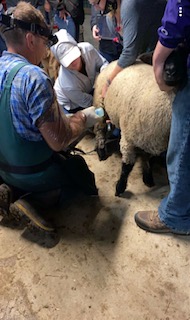
Me preg checking an ewe via ultrasound, photo by Abby Smith

Once I got to WIU I was quite nervous. Like I said, all I had was four years of agriculture from high school and I did not learn as much as I had expected to. My first semester at Western was a complete eye opener, I had learned so much about the ag community that I hadn’t even thought to know. I believe at this point was when I learned that ag really is a lifestyle, not a hobby. Farmers put their heart and soul into everything because usually it is what they live for. It is their livelihood.

Before I decided on agriculture science, I was just an indecisive science major. I knew that I loved biology but I couldn’t decide where I belonged. I knew that I could not be a doctor or a veterinarian, a lot of blood is not for me. So there I was, taking science class after science class not really having a chosen path. Once I started at WIU I decided to explore my options further and BOOM! I found ag science. It was a surprise to not only me but my family as well. But they are proud that I finally have purpose.

“Find out who you are, and do it on purpose.” -Dolly Parton

My experience as an ag student has been challenging, especially not coming from an ag background. But, the teachers at WIU have helped make me feel welcome and that I can do anything if I just put my mind to it. Being a senior makes these moments bittersweet, and ultimately wishing I had only chosen agriculture to be a part of my life much sooner.

Thank you for reading my blog post! My name is Stephanie Beaird. I am from Bushnell, IL. I am currently a senior at Western Illinois University. I am currently studying Ag Science as my major, with a minor in Ag Business.

Living the Best Life in a Corner Booth

Picture this, you arrived at college as a freshman, straight out of high school and eager to make friends with people in the same major as you. The first day of classes comes and goes, and you met many people but you’re too shy to say anything to anyone. That was me day one at Western Illinois University. To everyone I meet today they would think I was lying if I told them I used to not talk unless talked to. Forever I will be thankful for that corner booth.

This picture was posted on the WIUAg instagram page by Kay Montanez.

Every group of people has that significant spot they always meet up and hang out. For the agriculture students at WIU it was the corner booth, at least it was for as long as I could remember. Immediately coming to college that corner booth became the area I made all the best memories. It was the place my brother made me meet him on my first day of classes, right then and there it became my safe haven. Every day during lunch you could find three tables full of agriculture students. Most importantly you would find the people who I like to call my best friends. Second semester freshman year I would be there for three hours between classes, not one of those hours I would be alone. Because of that booth I had made more friends than I could count. I encourage anyone when first coming to college to step out of your comfort zone. You will never realize the memories or friends you are missing out on if you stay in your little bubble.

One of the most popular times this would be about half of the agriculture students who would join for lunch at the corner booth. This photo was posted on the WIU Ag Instagram page by Stephanie Miller.

No matter what kind of day you were having by the end of your break by sitting at that booth you would have a smile on your face. Multiple times I would be crying from the amount of laughter I was consumed in. The quote from the movie Winnie the Pooh “we didn’t realize we were making memories we just knew we were having fun” is extremely true when it comes to these moments. The friends I made or the clubs I joined I would have never thought about if it was not for the booth. I am so thankful every day that on the first day of school I decided to meet with my brother in the Union. With Covid-19 putting many restrictions on the university, we have not been able to meet at that corner booth which made me realize how important it was to me. Whether it was help for homework or just to turn my frown upside down I knew the corner booth would be able to do just that. It was this way for many people. Hopefully in the spring we are able to meet together at that corner booth again. 

“It was definitely a sense of community. No matter what time of day you walked in the union, you would find an Aggie sitting there eating or studying. You always knew you would be welcome to sit there. It meant friendship, laughter, and memories.”

Karissa Graves, Dec. 2019
Photo taken by the WIU Visual Production Center

Hello everyone! My name is Brianna Walsh and I am currently a senior majoring in agriculture education with a minor in agriculture mechanics technology. The place I like to call home is Jerseyville, IL. My future plans are to student teach in the Spring of 2022 and then find my next location that feels like home to serve as an agriculture education and FFA advisor. Here at Western I work as a student worker in the Ag Mechanics shop and as a greenhouse manager at Hart’s Nursery in Bushnell, IL. Currently I am a member of Sigma Alpha, Collegiate Farm Bureau, Ag Mechanics Club, Collegiate FFA/PAS/AgEd club, and the AgVocator Recruitment Team. Thank you so much for taking time out of your busy schedule to read my blog!